
RTA vs. Custom Cabinets: Pros and Cons for Your 2026 Remodel
The most expensive cabinet choice might be the one that fails to account for the unique atmospheric demands of your home. You’ve likely felt the tension between wanting a bespoke, high-end look and the practical desire to keep your 2026 remodel budget under control. It’s frustrating to see massive price gaps between retailers without a clear explanation of what you’re actually paying for. Understanding the RTA vs custom cabinets pros and cons is essential for any homeowner who values both technical mastery and aesthetic beauty.
We’ll show you how to find the perfect balance of luxury, durability, and value for your specific environment. You’ll learn which materials survive the dry Flagstaff air and how to achieve a custom feel without the custom lead times. We’re diving into the critical differences in material integrity, assembly logistics, and the latest design trends to ensure your kitchen remains a stunning, functional center for your life’s best moments. From the resurgence of natural white oak to the precision of engineered quartz, we’ll guide you through every choice to maximize your investment’s return.
Key Takeaways
- Define the spectrum between flat-packed RTA components and architectural custom builds to identify the best structural fit for your unique floor plan.
- Weigh the RTA vs custom cabinets pros and cons by analyzing how lead times and material grades impact your overall project timeline and budget.
- Master the technical requirements of the Northern Arizona climate to ensure your cabinetry resists warping and fading in high-altitude conditions.
- Audit your specific “must-have” features versus standard needs to determine which path provides the highest return on your 2026 remodel investment.
- Discover how professional in-house installation and expert design guidance can elevate RTA solutions to a custom-tier finish.
Defining the Spectrum: What Are RTA and Custom Cabinets?
Selecting the structural foundation for your kitchen transformation requires more than just an eye for color. It demands an understanding of the engineering behind your storage. To make an informed choice, you must first define the two primary paths available for your 2026 remodel. While the industry often frames this as a simple choice between price and quality, the reality is a sophisticated spectrum of manufacturing techniques and design philosophies. Evaluating the RTA vs custom cabinets pros and cons starts with a clear look at how these products are actually built.
Ready-to-Assemble (RTA) cabinets are professionally manufactured components that arrive at your home flat-packed. These units are produced in high-tech facilities to precise, standardized dimensions. The history and economic rise of Ready-to-assemble (RTA) furniture highlight how these products transitioned from simple utility to sophisticated home assets. On the other end of the spectrum, custom cabinetry is built from scratch. These are tailored to the specific architectural nuances of your space, allowing for total creative freedom without the constraints of standard sizing.
In 2026, the lines between these two categories have blurred significantly. High-end RTA lines now utilize materials and finishes that were once exclusive to custom shops. For many homeowners, the “assembly” part is only half the story. The true value lies in the marriage of high-grade components with professional installation, which can elevate even standard units to a bespoke appearance. Whether you’re aiming for a minor update or a major structural overhaul, the distinction lies in how the cabinetry integrates with your lifestyle and your home’s unique footprint.
The Anatomy of an RTA Cabinet
Modern RTA cabinetry focuses on precision and repeatable quality. Most premium lines now favor all-plywood box construction over cheaper particle board, providing the structural integrity needed for heavy stone countertops. Because these units are manufactured in three-inch increments, the design phase moves quickly. You’re not waiting for a shop to draft unique blueprints; instead, you’re selecting from a catalog of proven, durable configurations. Many of these lines now feature UV-resistant finishes and soft-close hardware as standard features, ensuring the aesthetic beauty lasts for years.
The Art of Full Custom Cabinetry
Custom cabinetry represents a “build-to-fit” philosophy. This path is essential for homes with unique architectural challenges, such as 45-degree angles, soaring ceiling heights, or the need for specialized wood species like walnut or rift-sawn oak. Since wood cabinets have officially surpassed white cabinets in popularity this year, the ability to select specific grain patterns and hand-applied artisan finishes is a major draw. Custom shops can create one-of-a-kind pieces that act as furniture, ensuring every inch of your kitchen is utilized with technical mastery and intentionality.
The Great Debate: RTA vs. Custom Cabinets Pros and Cons
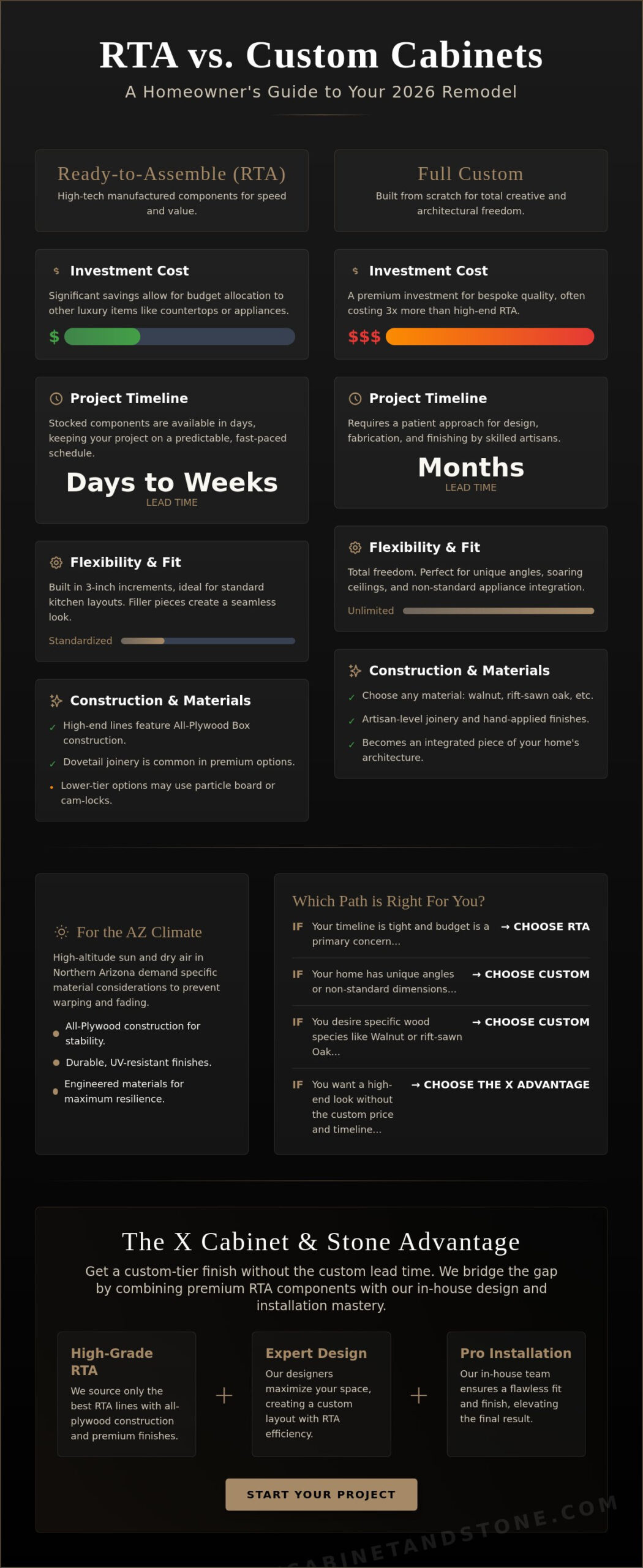
The decision between these two paths often comes down to the balance of time and investment. When analyzing RTA vs custom cabinets pros and cons, the most immediate differentiator is the project timeline. RTA units are typically available in days. In contrast, full custom cabinetry often requires months of lead time for design, fabrication, and finishing. This speed allows you to move from inspiration to installation with impressive momentum, keeping your remodel on a predictable track.
Budget distribution also plays a critical role in your decision. Choosing high-end RTA can free up significant resources for other luxury elements, such as premium natural stone slabs or high-end flooring. While custom cabinetry often costs three times more than high-end RTA, the investment buys you total architectural harmony. You aren’t just buying boxes; you’re buying a solution for every odd corner and unique ceiling height in your home.
Durability remains a focal point for many homeowners. High-quality RTA lines now frequently feature dovetail joinery, which was once a hallmark of custom work. However, some lower-tier RTA options still rely on cam-lock systems. While cam-locks are functional, they don’t offer the same long-term mechanical strength as the interlocking wood of a dovetail joint. Choosing the right joinery ensures your kitchen withstands the daily rigors of a busy household.
Advantages of Choosing RTA
RTA is the premier choice for those on a tight remodeling schedule. It offers immediate availability without sacrificing the look of a high-end kitchen. The factory-applied finishes are incredibly consistent, providing a level of coating uniformity that is difficult to replicate in a local woodshop. This reliability ensures that every door and drawer front matches perfectly, creating a cohesive visual narrative throughout your space. Understanding these RTA vs custom cabinets pros and cons makes it clear that RTA is about predictable excellence.
When Full Custom is Unbeatable
Full custom cabinetry is the right choice when your home demands a specialized touch. In historic Flagstaff properties, standard sizes often fail to account for settling floors or non-standard wall lengths. Custom builds allow for niche storage solutions like integrated wine chillers or hidden spice racks that disappear into the cabinetry. These tailored assets increase the long-term value of your property by maximizing every square inch. If you’re ready to see how these elements come together, exploring a premier interior design showroom can help you visualize the final transformation.
Material Integrity and the Northern Arizona Climate
Flagstaff’s 7,000-foot elevation presents a technical challenge that many generic cabinetry guides overlook. The high-altitude dryness and extreme seasonal shifts in Northern Arizona can be brutal on organic materials. When you’re weighing the RTA vs custom cabinets pros and cons, the climate must be your primary lens. Solid wood naturally expands and contracts as humidity fluctuates. In our arid environment, this movement can lead to unsightly gaps or structural cracking if the materials aren’t chosen with precision. Successful mountain-durable design requires components that are either acclimated to the region or engineered for stability.
There’s a common myth that custom builds always utilize “better” wood than RTA options. In reality, premium RTA lines often feature high-grade, multi-layer plywood that is specifically designed to resist the warping and shrinking common in solid planks. These plywood boxes provide the rigid foundation necessary for the heavy weight of natural stone or engineered quartz. While custom shops offer beautiful aesthetics, they sometimes rely on local sourcing that may not have the same rigorous moisture-control standards as a high-tech factory environment. Protecting your investment in custom kitchen cabinets in Flagstaff starts with selecting materials that respect the altitude.
The “secret sauce” for RTA longevity in a mountain home is professional assembly. A flat-packed cabinet is only as strong as its joints. When handled by experts, these units are squared, glued, and fastened with a level of precision that mimics the durability of a custom-built box. This professional touch ensures that the hardware remains aligned even as the house settles and the air dries out.
Plywood vs. Furniture Board in 2026
All-plywood construction is the gold standard for durability in 2026. It offers superior screw-holding power and resists the “sag” that can plague cheaper furniture board over time. However, in certain high-humidity areas like bathrooms, high-density fiberboard (HDF) can actually be more stable for painted doors because it doesn’t move as much as natural wood. Pairing these robust boxes with high-quality RTA hardware, such as Blum soft-close glides, ensures a high-end feel that lasts for decades.
Finish Durability: Factory-Applied vs. Shop-Applied
The science of the finish is where factory-applied coatings often outperform local shop-painted options. Modern factories use conversion varnishes and UV-cured finishes in climate-controlled rooms. These coatings are incredibly hard and resistant to the intense UV radiation found at higher elevations. Shop-painted custom cabinets can be beautiful, but the paint may chip or peel more easily in dry climates if the application environment isn’t perfectly controlled. For a mountain home, a factory-cured finish provides the best defense against fading and wear.
The Decision Framework: Which Path Suits Your Project?
Choosing between these two paths requires a clear-eyed look at your project’s specific goals. While the RTA vs custom cabinets pros and cons provide a theoretical baseline, your final decision should be driven by a structured framework. Start by auditing your timeline. If you’re planning a rapid transformation for a 2026 spring move-in, RTA units can be on-site in roughly two weeks. If your vision allows for a four-month lead time, the bespoke nature of full custom becomes a viable luxury. Your patience often dictates your level of creative control.
Next, define your “must-have” features. Standard needs like trash pull-outs and lazy Susans are easily handled by RTA lines. However, if your architectural plan requires cabinets to wrap around a stone fireplace or integrate a professional-grade wine station, custom work is essential. You should also analyze the return on investment for your specific neighborhood. In 2026, minor kitchen remodels often recover 70% to 85% of their cost, with some projects seeing returns as high as 113%. Major upscale remodels typically average a 50% to 65% return. Aligning your cabinetry spend with your home’s market value ensures you aren’t over-improving for the area.
Finally, evaluate your willingness to manage the logistics. RTA projects require either a high level of DIY competence or a partnership with a professional installer who understands factory-specified tolerances. If you prefer total accountability from a single entity, a full-service approach is the most reassuring path. You can explore these options in person by visiting our Flagstaff design center to see the quality differences firsthand.
The Middle Ground: Semi-Custom and Eclipse Cabinetry
Many Flagstaff renovations find success in the “sweet spot” of semi-custom solutions, such as Eclipse Cabinetry. This approach bridges the gap by utilizing standardized, high-quality boxes paired with a wider array of custom door styles and finishes. It offers the high-end, aspirational look of a bespoke kitchen without the extreme price tag or extended waiting periods of full custom shops. It’s a strategic choice for homeowners who want a personalized aesthetic but value practical reliability.
Calculating the Real Cost of Ownership
The price on the box is rarely the final number on the invoice. You must factor in the cabinet installation cost in Flagstaff, which varies based on the complexity of the layout and any structural modifications needed. While RTA offers flexibility for future replacements, custom cabinetry provides a long-term value that appeals to high-end buyers. Professional design guidance is the invisible element that ensures your chosen path results in a cohesive, functional center for your home.
The X Cabinet & Stone Advantage: Professional RTA Solutions
The assumption that RTA is strictly a DIY endeavor often keeps homeowners from achieving the high-end results they deserve. We’ve redefined the RTA vs custom cabinets pros and cons by introducing a total accountability model. We don’t just sell you a flat-packed box and leave the assembly to chance. Our team manages the entire fluid movement from initial inspiration to the final physical result. This comprehensive service model ensures that the precision of the factory build is matched by the mastery of our in-house installers, turning standard components into a high-end, custom-looking reality.
Our approach centers on the concept of transformation. We simplify complex processes by acting as your trusted advisor for every material choice. Beyond cabinetry, we help you select coordinating home materials like engineered quartz, natural stone slabs, and hardwood flooring. This ensures that your kitchen isn’t just a collection of parts, but a cohesive environment designed for durability and aesthetic beauty. By handling multiple specialized trades within a single entity, we eliminate the logistical headaches that typically overwhelm a 2026 remodel.
Our Flagstaff Design Center Experience
Visualizing your new space is a critical step in the journey. Visiting our interior design showroom allows you to touch and test our RTA and Eclipse Cabinetry lines in person. You can feel the weight of the drawers, test the soft-close glides, and compare finishes under realistic lighting. This sensory experience takes the guesswork out of the design phase. Our experts provide immediate guidance on how to pair your cabinet door styles with decorative tile or luxury vinyl plank, ensuring your vision is technically sound before the first box arrives.
Structural Mastery and Professional Installation
The success of a kitchen remodel often depends on what’s behind the cabinets. We provide structural remodeling services that most cabinet retailers simply won’t touch. Whether you’re moving a wall to create an open-concept gathering place or reinforcing floors for heavy stone counters, our in-house team handles the technical execution. This level of precision extends to the final details, where we use our cabinet hardware guide expertise to help you select the perfect knobs and pulls. Our installers ensure every unit is perfectly level and plumb, providing a reassuring atmosphere for your significant property investment.
Mastering Your Kitchen Transformation
Your 2026 remodel is more than a simple update; it’s a strategic investment in your home’s value and your daily quality of life. We’ve explored how high-grade materials withstand the unique high-altitude dryness of Northern Arizona and how professional assembly bridges the gap between standard components and bespoke beauty. Finalizing your decision on the RTA vs custom cabinets pros and cons requires weighing your specific architectural needs against your project timeline and budget goals. Whether you choose our premium RTA lines or the versatile Eclipse cabinetry, the result should be a space that reflects both technical mastery and your unique aesthetic vision.
Our Flagstaff-based structural remodeling experts are ready to handle the complex engineering of your project, from moving load-bearing walls to the final hardware placement. Our dedicated in-house installation team ensures every detail is perfect, providing total accountability for your transformation. Visit our Flagstaff Showroom to Compare RTA and Custom Options in Person and feel the quality of our high-grade components firsthand. You deserve a kitchen that serves as a durable, inspiring backdrop for your most significant life moments. We look forward to helping you bring that vision to life.
Frequently Asked Questions
Are RTA cabinets as strong as custom cabinets?
High-end RTA cabinets match the structural strength of custom builds when they feature all-plywood construction and professional assembly. The durability of a cabinet is determined by its joinery and material density rather than the location of its final assembly. By choosing units with dovetail drawer boxes and high-grade plywood, you ensure a foundation that rivals bespoke cabinetry in any high-use environment.
How much can I save by choosing RTA over custom cabinetry?
Homeowners typically find that high-end RTA solutions offer significant savings, often costing a fraction of what a full custom shop would charge for similar materials. This allows you to reallocate your budget toward premium assets like natural stone slabs or decorative tile. While project costs vary, the efficiency of factory-produced units is a primary reason they’ve become the preferred choice for value-conscious 2026 remodels.
Can I mix RTA cabinets with custom island features?
Mixing RTA perimeter cabinets with a custom island is an excellent way to balance high-end aspiration with practical reliability. You can use standard RTA sizes for the main run of the kitchen and invest in a custom-built island to act as a unique focal point. This hybrid approach allows for specialized features like integrated wine chillers while keeping the overall project timeline manageable and the aesthetic cohesive.
How long do RTA cabinets typically last in a high-use kitchen?
Quality RTA cabinets are designed to last 20 years or more in a high-use kitchen when they’re correctly installed. Their longevity is rooted in factory-cured finishes that resist moisture and heat better than many shop-applied paints. Understanding the RTA vs custom cabinets pros and cons helps you see that durability is a result of technical mastery and material choice, not just the custom label on the box.
Do RTA cabinets increase home value as much as custom ones?
Home value increases are driven by the final visual result and the quality of the installation rather than the cabinet’s assembly method. A professionally installed RTA kitchen that features trending wood tones and engineered quartz will provide a strong return on investment. Buyers in 2026 prioritize a high-end look and functional storage over the specific provenance of the cabinet boxes.
What is the biggest downside to buying custom cabinets?
The most significant downsides to custom cabinets are the extended lead times and the potential for finish inconsistency. Custom shops often require months to fabricate a single kitchen, which can stall your entire remodel. Additionally, local shops may lack the advanced UV-curing equipment found in large factories, meaning their finishes might chip more easily in the dry Northern Arizona climate over time.
Can RTA cabinets handle heavy quartz or granite countertops?
All-plywood RTA cabinets are specifically engineered to support the heavy weight of natural stone and engineered quartz. The structural integrity of a plywood box prevents the sagging or bowing that can occur with cheaper particle board alternatives. When these units are professionally leveled and secured by an in-house installation team, they provide a rock-solid foundation for even the thickest stone slabs.
How do I know if an RTA brand is high quality or just cheap?
You can distinguish high-quality RTA from inferior options by examining the joinery and hardware specifications. Look for solid wood drawer boxes with dovetail joints and soft-close glides from reputable manufacturers like Blum. A premium brand will also feature a multi-step factory finish that feels smooth to the touch and resists fingerprints, rather than a thin, rough-textured coating that lacks depth.


Be the first to comment