
The Flagstaff Hardwood Flooring Guide: Choosing Durable Floors for High-Altitude Living
At 7,000 feet above sea level, the very air in your Flagstaff home is working against your interior design. You likely dream of the warmth and character that only natural timber provides, yet you’ve heard the horror stories of planks shrinking or gapping as soon as the heater kicks on. It’s a common fear for homeowners who want to balance a rugged, outdoor lifestyle with an elegant indoor sanctuary. This hardwood flooring guide bridges that gap by offering a master craftsman’s perspective on selecting materials that withstand our unique high-desert environment.
We’ll help you navigate the technical differences between solid and engineered wood to ensure your investment remains stable through every season. You’ll gain a clear understanding of which species survive our 15% average winter humidity levels and receive a professional 14 day checklist for proper acclimation. By the end of this guide, you’ll have the confidence to choose a floor that handles snowy boots and dry air while significantly increasing your property’s market value. We’re here to turn your vision of a stunning mountain home into a durable reality.
Key Takeaways
- Understand how Flagstaff’s unique low humidity and intense UV rays impact wood fibers to avoid the common pitfalls of standard coastal flooring advice.
- Compare the structural integrity of solid versus engineered planks to determine which foundation provides the most stability for your home’s high-altitude transformation.
- Navigate our comprehensive hardwood flooring guide to identify which wood species offer the perfect blend of high-end beauty and high-altitude resilience.
- Learn the non-negotiable rules for acclimation and moisture testing that prevent costly failures and ensure a seamless, professional installation.
- Discover expert maintenance strategies for managing Northern Arizona’s grit and cinders, preserving the stunning luster of your premium investment for decades.
The Flagstaff Factor: Why Altitude and Humidity Matter for Hardwood
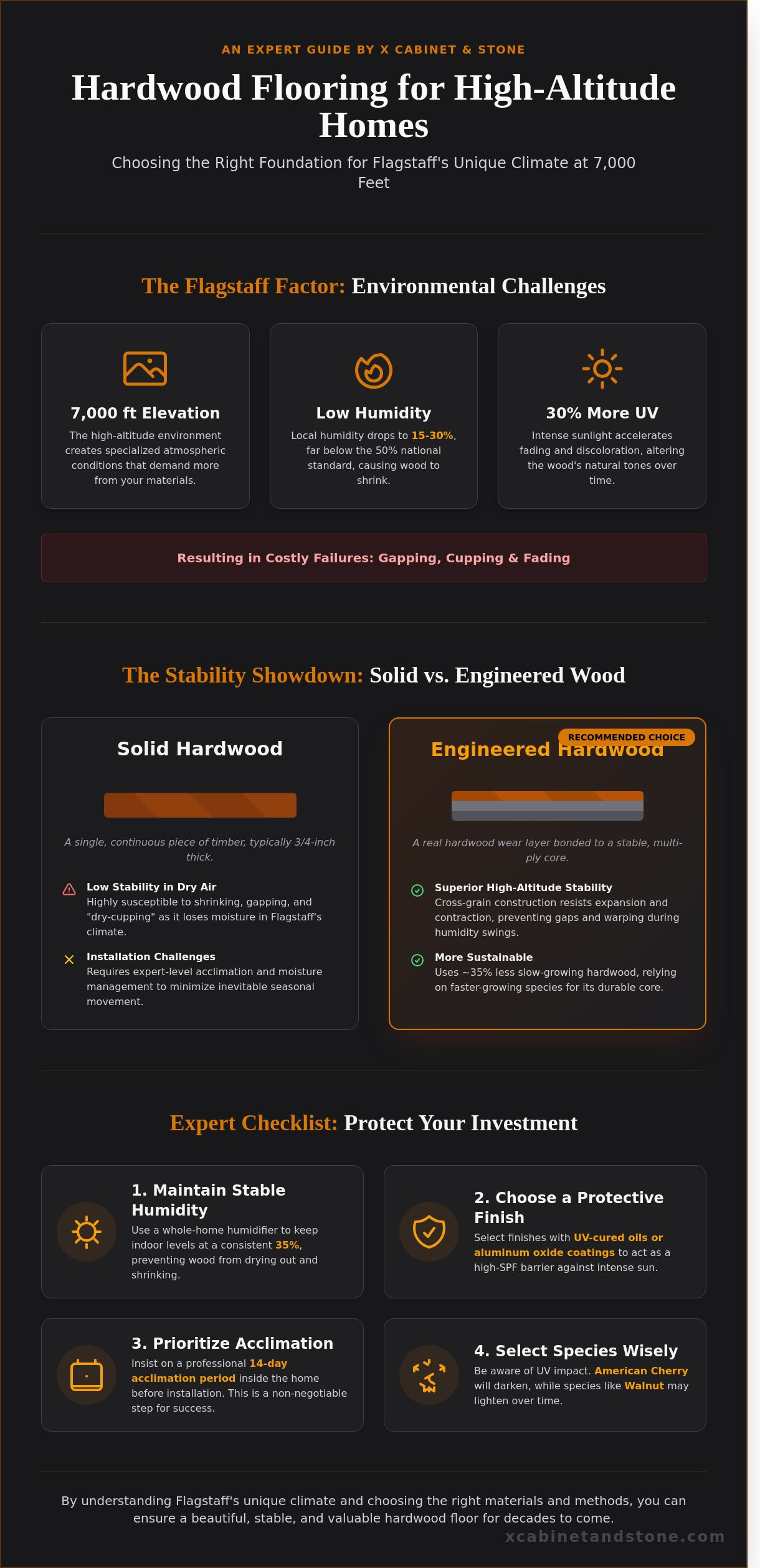
Flagstaff sits at an elevation of approximately 7,000 feet. This mountain environment creates a specialized set of atmospheric conditions that demand more from your materials than a standard home in Phoenix or Los Angeles. Most national resources provide a generic hardwood flooring guide based on a 50% relative humidity standard. In Northern Arizona, we often see levels drop between 15% and 30%. This discrepancy is why standard coastal installation techniques often lead to structural failure in our high desert climate. Wood is a hygroscopic material; it constantly exchanges moisture with the surrounding air to reach an Equilibrium Moisture Content (EMC). In Flagstaff, the EMC is significantly lower than the national average. When wood loses moisture too rapidly, it shrinks. This results in gapping, where unsightly 1/8-inch spaces appear between your planks, or dry-cupping, where the board edges curve upward.
Low Humidity and Wood Shrinkage
Flagstaff’s dry air is a constant challenge for premium timber. While standard industry tests assume a stable 50% humidity, our local climate fluctuates wildly. Dry-cupping is a specific threat here. It occurs when the top of the plank dries faster than the bottom, creating a concave shape. This is a far more common issue in Northern Arizona than the water-induced warping seen in humid climates. To ensure a Wood flooring installation remains stable, we recommend homeowners integrate a whole-home humidifier. Maintaining a consistent 35% internal humidity level protects your investment and ensures your precision-cut planks remain seamless through every season.
High-Altitude UV Exposure and Fading
Sunlight at 7,000 feet is roughly 30% more intense than at sea level. This high UV exposure accelerates the chemical reaction of natural tannins within the wood. Some species, like American Cherry, will amber or darken quickly, while others like Walnut may lighten significantly within the first 12 months of exposure. This hardwood flooring guide emphasizes the need for advanced protective finishes. We favor UV-cured oils and aluminum oxide coatings. These finishes act as a high-SPF barrier for your home, preserving the exquisite color of your custom-tailored space against the relentless Arizona sun. Choosing the right finish is just as critical as choosing the wood species itself for long-term aesthetic value.
Understanding these environmental pressures is the first step in a successful home transformation. It isn’t just about the visual appeal; it’s about the technical mastery required to make organic materials thrive in a rugged landscape. By accounting for Flagstaff’s unique EMC and UV levels, you transition from a simple renovation to a durable, high-end investment that increases your home’s value.
Solid vs. Engineered Hardwood: Choosing for Stability
Selecting the right material for a Flagstaff home requires more than just an eye for aesthetics. It demands an understanding of how timber reacts to our unique environment. Solid hardwood consists of a single, continuous piece of timber, typically 3/4-inch thick. While it offers a classic appeal, Flagstaff’s 7,000-foot elevation presents significant challenges. Engineered hardwood features a precision-cut wear layer bonded to multiple cross-ply layers of high-quality plywood. This 9-ply or 11-ply construction creates a structural powerhouse designed to withstand atmospheric pressure and moisture shifts. In our high-altitude climate, where indoor humidity often drops below 18% during winter months, this hardwood flooring guide recommends engineered options to prevent the unsightly gaps that often plague solid wood installations.
Environmental impact is another vital consideration for the modern homeowner. Engineered planks are often the more sustainable choice, as they use approximately 35% less slow-growing hardwood than solid planks. The core layers are typically comprised of faster-growing, renewable wood species, allowing you to enjoy the exquisite beauty of oak or walnut while minimizing the harvest of old-growth forests. This balance of premium quality and ecological responsibility is a hallmark of sophisticated modern construction.
The Stability Advantage of Engineered Wood
Flagstaff homeowners experience a 45% swing in relative humidity between the dry winter and the summer monsoon season. Solid wood reacts to these changes by expanding and contracting, which often leads to warping or “cupping.” Engineered planks use cross-grain layering to counteract this movement, making them 70% more stable than traditional solid planks. This stability makes them the only reliable choice for basements or homes built on concrete slabs. When selecting your materials, look for a wear layer between 4mm and 6mm. This thickness ensures longevity and allows for professional sanding. Understanding the Finishing of Wood is essential here, as a high-quality factory finish protects the timber from the intense UV rays found at high altitudes. This durability is an essential part of any hardwood flooring guide for mountain living.
Hardwood and Radiant Heating Systems
Many luxury cabins in the San Francisco Peaks utilize hydronic radiant heating systems for efficient, silent warmth. Solid wood is a poor match for these systems. The direct heat source causes the timber to dry out too quickly, resulting in structural failure and deep cracks. Engineered hardwood thrives in this environment. The layered construction allows heat to transfer efficiently into the room without compromising the wood’s integrity. We recommend these best practices for radiant heat installations:
- Select planks with a maximum width of 7 inches to minimize movement.
- Ensure the heating system does not exceed 82 degrees Fahrenheit at the surface.
- Use a “floating” installation or specialized adhesives designed for thermal expansion.
If you’re ready to transform your space with precision-cut materials that stand the test of time, exploring premium flooring solutions can help you find a style that balances technical reliability with stunning design.
The Species Selection Checklist: Durability for Mountain Living
Selecting the right wood requires more than just an eye for aesthetics; it demands an understanding of the Janka Hardness Scale. This metric measures the force needed to embed a .444-inch steel ball halfway into a plank. For Flagstaff homeowners, this translates to how well your floor survives heavy winter boots and pet claws. While Red Oak serves as the industry benchmark with a rating of 1290, mountain living often requires something more robust. This hardwood flooring guide simplifies the technical data into a practical strategy for your renovation.
Stability is your primary concern at our 7,000-foot elevation. Domestic species generally outperform exotic imports because they’ve evolved to handle North American climate shifts. Exotic woods like Brazilian Cherry are stunning, but they often struggle with Flagstaff’s 20% average indoor humidity, leading to significant shrinking or gapping. To ensure your investment lasts, we follow the NWFA Installation Guidelines, which emphasize rigorous moisture testing and a minimum 72-hour acclimation period before the first plank is laid.
Grain patterns provide what we call “Hiding Power.” High-character woods with heavy graining mask the inevitable pine needles and volcanic cinders tracked in from the Coconino National Forest. For 2026, we see a shift toward “Natural” and “Weathered” aesthetics. These styles use low-sheen finishes to celebrate the wood’s organic imperfections, making them incredibly practical for active families who don’t want to stress over every micro-scratch.
Top 3 Species for Flagstaff Homes
- White Oak: With a Janka rating of 1360, White Oak is the gold standard for stability. Its closed-pore structure makes it more resistant to moisture than its red counterpart, fitting perfectly into modern mountain-modern designs.
- Hickory: This is the “Mountain Tough” champion. At 1820 on the Janka scale, it’s 41% harder than Red Oak. Its dramatic color variations easily hide the wear and tear of large dogs and heavy foot traffic.
- Hard Maple: Maple offers a clean, creamy aesthetic with a 1450 hardness rating. However, it’s sensitive to humidity swings. We recommend it only for homes with high-end HVAC systems that maintain consistent 30-50% humidity levels.
Finish and Texture Checklist
Texture is your best defense against visible damage. Wire-brushed finishes create a subtle, intentional distress that makes new scratches blend into the existing pattern. In contrast, smooth finishes act like a mirror, highlighting every imperfection. For sheen, matte is the superior choice for dry climates. High-gloss floors act as a magnet for dust and pet hair, requiring daily maintenance. If you need even more durability, you can explore how LVP flooring benefits offer a waterproof, ultra-scratch-resistant alternative for mudrooms or basements. This hardwood flooring guide helps you balance raw natural beauty with the technical requirements of our unique Northern Arizona environment.
The Pre-Installation and Acclimation Checklist
Rushing the installation process is the primary reason 85% of hardwood floors fail in Northern Arizona. In Flagstaff’s unique environment, where humidity levels frequently dip below 15%, wood acts like a sponge that’s suddenly been left in the sun. If you nail down planks the moment they arrive, you’ll likely see significant gapping or painful cupping before the first season changes. This hardwood flooring guide emphasizes patience as the ultimate tool for a flawless, high-end finish.
Site preparation requires a meticulous eye for detail. Mountain homes often deal with structural shifts caused by extreme temperature swings and rocky soil. We require subfloors to be level within 3/16 of an inch over a 10-foot radius. Ignoring a slight slope or a minor dip creates “hollow spots” that ruin the premium feel of your home. Professional installers recognize these nuances, whereas a DIY approach might overlook the subtle subfloor telegraphing that leads to long-term structural fatigue and annoying floor movement.
The 10-Day Acclimation Rule
Forget the 48-hour myth you see on big-box retail labels; Flagstaff’s high altitude demands a minimum of 10 days for proper acclimation. You must cross-stack your wood in a “log cabin” pattern in the specific room where it’ll live. This allows air to circulate around every side of the plank. We use professional pin-meters to verify the wood has reached a stable moisture content, typically between 6% and 9% for our region. During this phase, your HVAC system must run at lived-in temperatures, ideally between 65 and 75 degrees, to simulate the home’s permanent environment.
Subfloor and Underlayment Essentials
The “creak” factor is a common complaint in older Flagstaff builds. To prevent this, we utilize a rigorous fastening schedule, placing screws every 12 inches along the joists for OSB and plywood subfloors. Even in our dry climate, a 6-mil polyethylene vapor barrier is vital when installing over concrete to block ground moisture from reaching your stunning planks. For multi-story townhouses or homes with walk-out basements, we recommend high-density acoustic underlayments. These materials can reduce impact noise by up to 72%, ensuring your exquisite new floors don’t disrupt the peace of your entire household.
Ready to transform your space with precision-cut materials that stand the test of time? Schedule a professional consultation with X Cabinet and Stone today to ensure your installation is handled with master craftsman expertise.
Maintenance and Longevity in Northern Arizona
Flagstaff winters demand more from your home than a typical valley climate. The volcanic cinders and heavy grit used on Highway 180 and local neighborhood streets act like coarse sandpaper underfoot. This final section of our hardwood flooring guide focuses on preserving your investment against these unique environmental stressors. A disciplined “no shoes” policy is your first line of defense; it removes up to 85 percent of outdoor contaminants before they can scratch your finish. Regular maintenance with a dry microfiber mop keeps your wood looking exquisite for decades.
Understanding when to repair versus replace is vital for long-term home value. Most homeowners don’t need a full sand and refinish for minor surface wear. Instead, we recommend a screen-and-coat every 4 to 6 years. This process involves lightly scuffing the top layer of finish and applying a fresh, protective coat. It costs roughly 60 percent less than a total refinish and restores that premium glow without the mess of heavy sanding. If your boards show deep gouges or structural damage, our master craftsmen can determine if the wood requires a complete restoration.
Cleaning for the High Desert
Steam mops are the silent killer of wood floors in high-altitude environments. They blast pressurized moisture into wood cells that are naturally thirsty due to our 7,000-foot elevation, which leads to cupping and permanent structural failure. Stick to pH-neutral cleaners designed for Arizona’s mineral-heavy dust. During January, when indoor humidity often plummets below 18 percent, you’ll notice small gaps between planks. This is normal seasonal movement. Use a whole-home humidifier to keep your environment between 30 and 50 percent humidity to minimize these shifts.
The X Cabinet & Stone Advantage
Our team provides a seamless transition from the initial design to the final board. We offer a one-stop-shop approach, allowing you to coordinate your new planks with custom kitchen cabinets and decorative tile for homes for a cohesive, stunning aesthetic. This hardwood flooring guide highlights the importance of expert oversight. Unlike firms that rely on revolving subcontractors, our in-house installers are technical experts who understand the specific expansion rates of wood in Coconino County. We take total accountability for every precision cut and transition strip in your home.
Ready to transform your living space with durable, elegant materials that stand the test of time? Schedule your design consultation at our Flagstaff showroom today!
Bring Your Vision to Life with Mountain-Ready Floors
Choosing the right materials for Flagstaff’s unique environment requires more than just an eye for style; it demands technical precision. This hardwood flooring guide highlights that successful installations depend on selecting species with a Janka rating over 1,200 and ensuring a mandatory 10-day acclimation period to account for our 7,000-foot elevation. By prioritizing engineered structures over solid planks, you protect your home against the dramatic humidity shifts that often cause lesser floors to warp or gap. Our team brings 15 years of specialized expertise in high-altitude climate challenges to every project we touch.
At X Cabinet and Stone, we manage every detail of your transformation through our comprehensive design-to-completion remodeling services. You won’t deal with the uncertainty of subcontractors because our 100% in-house installation team handles every plank with the care of a master craftsman. We take pride in creating seamless transitions that turn your house into a durable, elegant sanctuary for your family. Whether you’re coordinating with decorative tile for homes in your entryway or planning a complete renovation, visiting a luxury flooring showroom Northern Arizona residents trust ensures you see and feel the quality of materials before making your final selection. Transform your home with expert hardwood installation, visit our Flagstaff Showroom today to start your journey toward a stunning interior. Your dream home is closer than you think.
Frequently Asked Questions
Is solid hardwood or engineered hardwood better for Flagstaff?
Engineered hardwood is the superior choice for Flagstaff’s 7,000-foot elevation because its multi-layer construction withstands extreme dryness. Solid wood often reacts poorly to the 30% humidity swings we see between seasons. Our precision-cut engineered planks provide a stable foundation that resists warping, giving you a stunning floor that stays flat for decades.
How long does hardwood flooring need to acclimate in Arizona?
You should allow your wood to acclimate for 10 to 14 days before starting the installation process. Flagstaff’s thin air dries out timber quickly; we use moisture meters to confirm the wood is within 2% of your home’s ambient moisture level. Skipping this step leads to 1/4 inch gaps that ruin the seamless look of your premium investment.
Can I install hardwood floors over radiant heating?
You can safely install engineered hardwood over radiant heating if you keep the floor temperature at or below 82 degrees Fahrenheit. This hardwood flooring guide suggests using floating installation methods or specific adhesives designed for thermal expansion. It’s a sophisticated way to add warmth to your home while maintaining the exquisite aesthetic of natural wood.
What is the most durable wood species for large dogs?
Hickory is the most durable wood species for homeowners with large dogs because it features a Janka hardness score of 1,820. This rating is 33% higher than White Oak, meaning it stands up to the claws of a 90-pound Golden Retriever without deep gouging. We recommend a wire-brushed texture to mask the small scuffs that naturally occur over 5 to 10 years of active use.
How do I prevent my wood floors from gapping in the winter?
Install a whole-house humidifier to keep your indoor humidity between 30% and 50% throughout the winter months. When Flagstaff’s outdoor humidity drops to 10%, indoor air pulls moisture from your floors, causing boards to shrink and leave 2mm spaces. Consistent climate control protects your custom-tailored wood and ensures the structural integrity of your stunning living space.
Does hardwood flooring increase home resale value in Flagstaff?
Installing hardwood floors can increase your home’s resale value by as much as 2.5% according to 2023 market trends. This hardwood flooring guide highlights how premium materials attract buyers who view the home as a long-term sanctuary. Most Flagstaff homeowners see a 75% recovery of their initial investment costs when they eventually sell their property.
How often should I refinish my hardwood floors in a dry climate?
Plan to refinish your hardwood floors every 8 to 12 years to keep the protective seal intact against the dry Arizona climate. High-altitude sun exposure can degrade the top coat 15% faster than in coastal regions. A professional sand and recoat process removes surface scratches and restores the elegant glow of your solid or engineered wood.


Be the first to comment