
Engineered Quartz vs. Granite Cost: 2026 Flagstaff Homeowner’s Guide
The lower sticker price on a natural stone slab might actually be the most expensive mistake you make in your 2026 remodel. When evaluating engineered quartz vs granite cost, most Flagstaff homeowners focus solely on the initial quote, yet the real investment value lies in the years of ownership that follow. You want a kitchen that remains a stunning centerpiece for gatherings without becoming a source of hidden maintenance stress or unexpected upkeep fees.
It’s frustrating to navigate confusing price tiers and local installation rates while trying to balance aesthetic beauty with a realistic budget. We understand that your home is your most significant asset, and every detail should reflect a commitment to quality and technical mastery. This guide provides a definitive price breakdown and a long-term value comparison to help you make the smartest investment for your property. You’ll discover exactly how material choices impact your ROI, how professional installation synergy changes the bottom line, and which surface perfectly complements your cabinetry for a cohesive, high-end transformation.
Key Takeaways
- Evaluate the real-world engineered quartz vs granite cost for 2026, comparing upfront slab prices against long-term performance in Flagstaff homes.
- Identify hidden expenses like the maintenance tax for granite sealing and specialized cleaners that can add hundreds of dollars to your investment over time.
- Learn how to optimize your budget by pairing high-end quartz or natural stone with RTA cabinets, allowing for a luxury finish without overextending your finances.
- Understand why Flagstaff’s high-altitude environment requires specific material considerations, particularly regarding UV exposure and structural cabinet support.
- Discover the efficiency of an integrated installation model that handles everything from structural changes to the final stone placement for total project accountability.
Engineered Quartz vs. Granite Cost: The 2026 Market Landscape
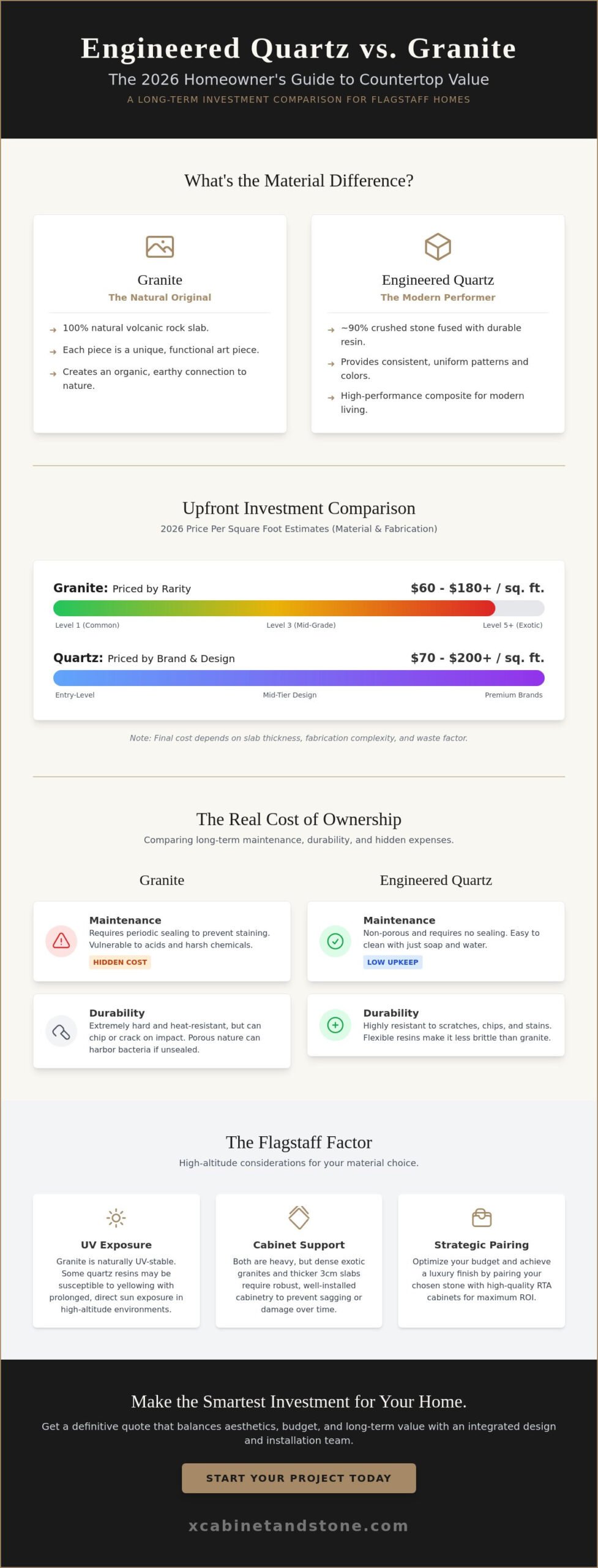
Selecting the right surface for your Flagstaff home involves more than just picking a color. In 2026, the engineered quartz vs granite cost is shaped by a stabilized global supply chain and specific regional logistics. Granite remains a 100% natural volcanic rock slab, harvested from quarries to showcase unique geological patterning. No two pieces are identical; each slab features a distinct history written in stone. On the other hand, Engineered Quartz Surfacing is a high-performance composite consisting of approximately 90% crushed stone and durable resin. This man-made precision allows for a level of consistency and durability that natural stone cannot always match.
We view these materials as tangible assets rather than just decorative finishes. A high-quality countertop is a strategic investment in your property’s resale value and daily functionality. While the market has seen prices level off compared to the volatility of previous years, the cost in Northern Arizona still reflects the specialized handling required for heavy stone slabs. Choosing between them requires a balance of aesthetic aspiration and practical reliability, ensuring your kitchen remains the heart of your environment for decades. This philosophy of quality also extends to other spaces; for instance, Countertops and Cabinetry By Design demonstrates how these same premium material choices can be used to create a cohesive, high-end look in a bathroom remodel.
The Aesthetic vs. Functional Investment
Granite serves as a functional art piece in the kitchen. Its natural variations create a sense of movement and depth that feels grounded and organic. It’s the perfect choice if you want a kitchen that feels connected to the rugged beauty of the Arizona landscape. Quartz offers a different kind of luxury. It provides the clean, sophisticated lines and uniform patterns that define modern transformations. For busy families, the functional appeal of a non-porous, stain-resistant surface often outweighs the desire for natural geological variation. You aren’t just buying a surface; you’re choosing the backdrop for your family’s most significant life moments.
Why Price Tiers Matter More Than Material Labels
The total engineered quartz vs granite cost is often determined by specific tiers rather than the material category alone. Granite pricing typically follows a Level 1 to Level 5 structure. Level 1 represents high-availability slabs with consistent patterns, while Level 5 includes rare, exotic stones that function as high-end focal points. Quartz pricing is heavily influenced by brand prestige. Manufacturers like Caesarstone or Silestone offer exclusive colorways and textures that sit at the top of the price scale. Additionally, slab thickness plays a vital role. A 3cm slab offers a bold, premium profile but requires a larger investment in both material and structural support than a standard 2cm slab. Understanding these nuances ensures you select a material that fits your design vision and your financial plan perfectly.
Breaking Down the Price Per Square Foot: 2026 Estimates
Understanding the total engineered quartz vs granite cost requires looking beyond the price tag on a single slab. Your final estimate is a combination of material rarity, fabrication complexity, and the waste factor. The waste factor refers to the unused portions of a stone slab that you must still purchase to accommodate the specific layout of your kitchen. While prefabricated counters can reduce this cost, a custom-cut slab ensures a seamless fit for unique architectural features. We focus on maximizing the yield of every slab to ensure you receive the highest value for your investment.
Granite Pricing: From Common to Exotic
Standard granite remains a favorite for homeowners who want the durability of natural stone without the premium price of rare minerals. These slabs typically feature consistent, speckled patterns that are widely available. However, the price climbs quickly when you move into exotic territory. Rare colors like blue van Gogh or slabs with heavy veining can easily surpass the price of even the most expensive quartz. Because granite is heavy and fragile, shipping these unique pieces to Northern Arizona adds a logistical layer to the cost. We manage these logistics with precision, ensuring that your chosen “art piece” arrives safely for installation.
Quartz Pricing: Brand Authority and Engineering
Quartz offers a more predictable pricing structure because it’s a manufactured product. You aren’t at the mercy of what a quarry yields on a given day. Instead, the cost is driven by brand authority and the complexity of the design. A solid white or gray quartz is generally more accessible than a slab engineered to mimic the intricate veining of Calacatta marble. According to Forbes’ 2024 Countertop Comparison, the technological mastery required to create these hyper-realistic patterns is a significant factor in modern pricing. This engineering ensures that your counters don’t just look beautiful but also perform flawlessly in high-traffic environments.
Labor costs also fluctuate based on the finishing touches you choose. Standard edge profiles like a square or eased edge are typically included in basic fabrication, but more decorative options like bullnose, bevel, or mitered edges require additional shop time. A mitered edge, which creates the illusion of a much thicker slab, involves complex 45-degree cuts and expert assembly. If you’re planning a Kitchen Remodel in Flagstaff, these details are where the skill of a master artisan becomes most apparent. By selecting the right combination of material tier and edge detail, you can achieve a sophisticated result that aligns with your financial goals.
Hidden Costs: Maintenance, Durability, and the Flagstaff Factor
Living at 7,000 feet introduces environmental variables that don’t exist in lower-elevation designs. When calculating the engineered quartz vs granite cost, you must look past the installation day to the next decade of performance. Northern Arizona’s intense UV exposure and dry climate affect how these materials age, potentially turning a budget-friendly choice into a long-term liability if you don’t plan for maintenance. We believe in providing high-quality, tangible assets that increase your property value, which requires a deep understanding of how mountain living impacts stone chemistry.
The most significant “hidden” expense is the maintenance tax associated with natural stone. Granite is porous and requires regular sealing to prevent staining and bacterial growth. Industry data suggests homeowners spend between $15 and $200 annually on DIY sealing supplies, while professional applications can cost $200 to $400 per visit. Over a ten-year period, these costs accumulate, whereas engineered quartz requires zero sealing. However, quartz has a technical vulnerability: heat resistance. While granite can withstand temperatures up to 1,200°F, quartz resins can scorch at 300 to 400°F. A permanent scorch mark on quartz is often more expensive to repair than a minor chip in granite, making your cooking habits a primary driver of long-term value.
The Sealing Cycle for Natural Stone
Flagstaff’s notoriously dry air can accelerate the evaporation of stone sealants, often requiring a more frequent sealing cycle than the standard one to three years recommended in more humid climates. If you prefer a “set it and forget it” lifestyle, quartz offers incredible value because it remains non-porous for its entire lifespan. For those who choose the unique beauty of natural stone, staying ahead of the sealing cycle is critical to protecting your investment from the red wine or coffee spills that can permanently shadow unsealed granite.
Environmental Resistance in Northern Arizona
UV stability is a specific requirement for sun-drenched Flagstaff kitchens. Engineered quartz consists of 90% to 94% ground stone mixed with pigments and resins. In homes with large, south-facing windows, lower-quality resins can yellow or become brittle under intense high-altitude sunlight. Granite is naturally UV-immune, making it a superior choice for outdoor kitchens or highly exposed areas. Additionally, both materials offer excellent scratch resistance. Quartz holds a Mohs hardness of 7, while granite sits slightly lower at 6 to 6.5, ensuring both can handle the rugged, high-traffic demands of a mountain home without losing their aesthetic luster.
Strategic Pairing: Countertops and RTA Cabinetry Synergy
Your kitchen counters don’t exist in a vacuum. They rely on the structural integrity and aesthetic alignment of the cabinets beneath them. When you analyze the engineered quartz vs granite cost, it’s vital to consider how your cabinetry choice impacts the total project budget. Many homeowners find that by selecting high-quality RTA cabinets Flagstaff, they can save enough on labor and assembly to upgrade from a standard stone slab to a premium, exotic surface. This “high-low” design strategy is a hallmark of professional remodeling, allowing you to invest your dollars where they make the most visual impact without sacrificing durability.
For those aiming for a more tailored aesthetic, Eclipse cabinetry offers the sophisticated, custom-built look that perfectly justifies a top-tier quartz investment. We often guide clients to think like they are in a luxury flooring showroom Northern Arizona, where every material is chosen to complement the next. Coordinating the veining in a granite slab with the wood grain of your cabinets and the undertones of your flooring creates a sense of harmony. It’s about more than just the engineered quartz vs granite cost; it’s about the fluid movement from the design phase to a breathtaking physical result.
Maximizing ROI with RTA and Stone
Sourcing your cabinetry and stone from a single entity ensures total accountability and design cohesion. You can use a comprehensive cabinet hardware guide to select the finishing touches that tie your stone and wood together. This integrated approach simplifies a complex process, turning a potentially stressful remodel into an exciting transformation. When you buy your cabinets and countertops together, you also ensure that the measurements are perfectly synchronized, reducing the risk of costly fabrication errors.
Structural Considerations for Heavy Slabs
Weight is a technical detail that requires expert attention. A 3cm natural stone slab typically weighs between 15 and 20 lbs per square foot. This puts a significant load on your cabinet boxes, especially across long spans like kitchen islands. While engineered quartz is also heavy, its consistent composition makes it slightly more predictable. However, both materials demand a level of structural mastery during installation. By coordinating home materials early in the planning phase, you can ensure your cabinet boxes are reinforced where necessary to support the massive weight of your chosen stone. This meticulous planning protects your investment and ensures your kitchen remains the heart of your home for decades.
Ready to see these materials in person? Browse the curated selections at X Cabinet & Stone to find the perfect pairing for your next project.
The X Cabinet & Stone Advantage: In-House Installation
The final calculation for your engineered quartz vs granite cost isn’t complete until you account for the execution. Even the most exquisite slab loses its value if the installation is flawed or the structural support is insufficient. We take pride in acting as a creative strategist for your home, managing the fluid movement from the initial design phase to the final physical result. By maintaining total accountability through our in-house installation services, we ensure that the technical mastery of our work matches the aesthetic beauty of the materials you’ve selected.
Our capabilities extend beyond simple stone placement. Because we specialize in structural remodeling, we can handle complex countertop layouts that require modified wall supports or custom island framing to manage the immense weight of 3cm stone. This comprehensive service model simplifies the process, allowing you to focus on the excitement of your kitchen’s transformation while we handle the intricate technical details. You won’t have to juggle multiple specialized trades; we provide a single point of contact for a seamless, professional experience.
Total Accountability from Design to Install
Eliminating the middleman is one of the most effective ways to protect your budget. Unlike retailers that rely on third-party subcontractors, our dedicated in-house teams handle every step of the templating and fabrication process. This integrated approach reduces the risk of communication gaps and scheduling delays, which are common when multiple companies are involved. By sourcing your cabinets and stone from one entity, you benefit from a tighter renovation timeline and a project estimate that reflects the efficiency of our internal logistics. We treat every Flagstaff home with the meticulous care it deserves, ensuring every seam is tight and every edge is polished to perfection.
Expert Guidance in the Flagstaff Showroom
Photos can only tell part of the story. To truly understand the depth of a granite slab or the subtle texture of a quartz surface, you need to see them under the unique lighting conditions of Northern Arizona. We invite you to explore our interior design showroom Northern Arizona to view our curated selection of slabs in person. Our artisans are available to explain the technical specifications of each material, helping you balance the engineered quartz vs granite cost against your specific lifestyle needs. Visit our Flagstaff showroom today to find the perfect stone for your next project and begin the journey toward a home that reflects your highest aspirations.
Transform Your Flagstaff Kitchen with Expert Guidance
Your kitchen remodel is an investment in your home’s future and your family’s daily joy. We’ve explored how the engineered quartz vs granite cost isn’t just about the initial slab price. It also includes the long-term maintenance tax of natural stone and the environmental impact of Flagstaff’s high altitude. By choosing high-quality RTA cabinets, you can unlock the budget needed for premium surfaces that truly transform your space and increase your property’s value.
Success in a major renovation comes down to accountability and technical mastery. As Northern Arizona’s premier design showroom, we specialize in structural remodeling and material coordination to ensure your vision becomes a durable reality. Our in-house installation experts handle every detail from the first template to the final polish, giving you the confidence of a perfectly executed project. We take the time to ensure every technical specification supports your aesthetic goals.
Don’t leave your investment to chance with subcontractors or generic retail advice. Schedule Your Design Consultation at X Cabinet & Stone today to see our curated slabs and start your journey toward a stunning, high-value home transformation. We look forward to helping you create a space that remains the heart of your environment for years to come.
Frequently Asked Questions
Which is more expensive per square foot: quartz or granite in 2026?
The engineered quartz vs granite cost typically overlaps in the current market, though granite offers a wider pricing spectrum. Entry-level granite slabs often provide a more accessible starting price than standard quartz. Conversely, rare exotic granite can reach price points far higher than even the most premium engineered brands. Quartz pricing remains more predictable because it isn’t subject to the geological rarity or quarrying volatility that affects natural stone.
Does quartz or granite have a better resale value for Arizona homes?
Both materials are considered high-grade assets that can recover 60% to 80% of their cost during a home sale. In 2026, many Arizona buyers show a slight preference for quartz due to its modern look and reputation for being maintenance-free. However, in luxury mountain properties, a unique granite slab functions as a one-of-a-kind art piece that can significantly boost a home’s aspirational appeal.
Is granite harder to maintain than engineered quartz?
Granite requires more active care because it is a porous natural material. You must seal it periodically to prevent moisture and bacteria from seeping into the stone. Quartz is non-porous and never requires sealing, making it nearly effortless to keep clean. For homeowners who prioritize a low-maintenance lifestyle, quartz offers a significant functional advantage over the lifetime of the kitchen.
Can quartz countertops be used in outdoor kitchens in Flagstaff?
Quartz is generally not suitable for outdoor installations in Northern Arizona. The intense UV exposure at Flagstaff’s high altitude can cause the resins used in quartz to yellow, fade, or become brittle over time. Granite is a 100% natural volcanic stone that is immune to sun damage. It remains the professional choice for outdoor cooking spaces that need to withstand the elements without losing their structural integrity.
How much does professional countertop installation cost in Northern Arizona?
The cost of installation depends heavily on the complexity of your kitchen layout and any necessary structural remodeling. Factors such as the number of sink cutouts, the type of edge profile, and the weight of 3cm slabs all influence the labor required. Choosing a team that handles both fabrication and installation ensures that every technical detail is managed under one roof for better project accountability.
Does granite stain more easily than quartz?
Granite can stain if the protective sealant is compromised or neglected. Because it’s a natural stone, it has microscopic pores that can absorb oils, wine, or acidic liquids. Quartz is engineered to be completely non-porous, meaning liquids sit on the surface rather than soaking in. This makes quartz an exceptionally reliable surface for high-traffic kitchens where spills are a common occurrence.
What are the hidden costs of natural stone countertops?
The “maintenance tax” is the primary hidden cost of natural stone, including the price of sealants and specialized pH-neutral cleaners over the years. You should also consider the cost of potential repairs; while granite is heat-resistant, it can chip if struck by a heavy pot. Quartz is more flexible and chip-resistant but can be permanently damaged by high heat, leading to expensive professional restoration if a scorch occurs.
How do I choose between quartz and granite for an RTA cabinet kitchen?
Your choice should balance your aesthetic desires with the structural capacity of your cabinetry. High-quality RTA cabinets are built to support the 15 to 20 lbs per square foot of heavy stone slabs, but you should always confirm your layout’s load-bearing limits. Many homeowners find that the savings from RTA cabinets allow them to upgrade to a more exotic granite or a premium quartz pattern, resulting in a high-end transformation.


Be the first to comment